
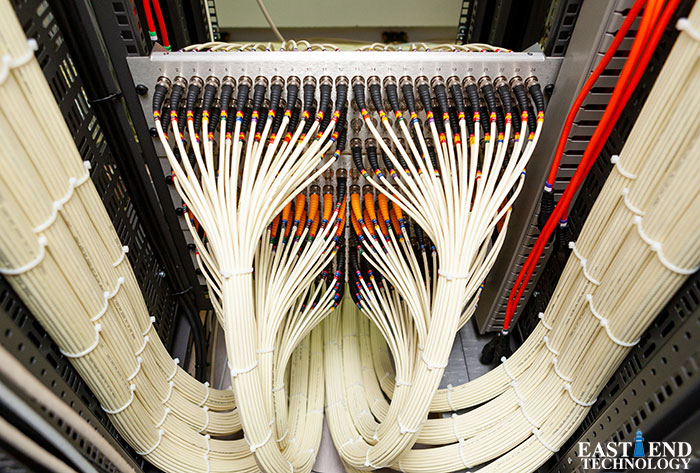
Network Cabling Solutions: Poor network cabling can be responsible for as much as seventy percent (70%) of a company’s network issues; however, most companies do not take into consideration an important part of their operation: network cabling. Network cabling is the “backbone” of a company, enabling all devices to send and receive information. Poorly designed cabling infrastructure will deliver substandard performance and higher maintenance costs, ultimately failing to meet the operational productivity your company requires. The average life expectancy of any cabling system is ten (10) years.
In this piece, we’ll walk you through the different types of network cables and wires. You’ll learn the key benefits of professional network and cabling solutions and how to select the right network cable wiring for your business needs.
Learning About Different Cables Used in Network Cabling Solutions
The three cable types that make up the majority of networking and cabling options are twisted-pair Ethernet cables (copper), fiber-optic cables, and coaxial cables, each used for specific use cases. Each type of cable serves a specific purpose, depending on the application’s bandwidth requirements and how far the signal must travel from the source to the destination.
Twisted-pair copper Ethernet cables dominate the commercial space, having been the industry-standard choice for many years. The Cat5e can run 1 Gbps at 100 MHz over 100 meters. Cat6 can run 10 Gbps over approximately 55 meters; after that, it falls back to 1 Gbps for longer runs of the same distance. Cat6a extended Cat6’s 10-Gbps performance to reach the full 100-meter distance at a bandwidth of 500 MHz. Lastly, Cat8 can achieve 40 Gbps over a 2 GHz bandwidth; however, its maximum length is just 30 meters. In addition to the above-mentioned speed capabilities, twisted-pair copper Ethernet cables also support Power Over Ethernet (PoE). PoE allows one cable to provide both Data and DC Power. The latest version of this standard, IEEE 802.3bt, now supports up to 90 watts per port. This level of wattage is more than enough to power laptops, LED Lighting, and other Smart Building technologies.
Coaxial cables still continue to play an important role in cable TV service delivery, broadband Internet services delivered via Hybrid Fiber-Coax (HFC) networks, and Closed-Circuit Television (CCTV) Security Systems. The most widely available coaxial cable product used today is RG-6.
Performance Advantages of Professional Networking & Cabling Services
Wired professional networking & cabling services can deliver better performance than wireless technologies. Wired technology can reach speeds of 10 gigabits/second, whereas wireless Wi-Fi technology achieves top speeds (when there is no other wireless traffic) of approximately 9.6 gigabits/second; however, this speed is achievable only under optimal conditions. The actual performance of Wi-Fi in real-world applications is typically much slower due to interference from nearby electronic devices, construction materials, excessive network traffic, and environmental factors such as weather.
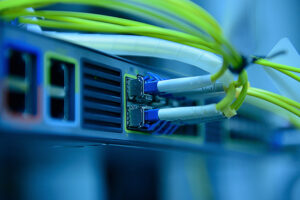
Physical reliability is another major benefit of utilizing wired technologies. Unlike wireless signals, which degrade rapidly over long distances, physical cables do not. In addition, physical cables are immune to interference caused by local electronic devices and/or structural elements in buildings, network congestion, or adverse environmental conditions. When properly installed, high-quality wired networks offer ultra-low latency (sub-ms) and virtually zero packet loss, resulting in continuous flow of data. Therefore, wired networks are suitable for mission-critical servers, POS terminals,, and desktop computers requiring guaranteed uptime.
The physical security advantages of wired infrastructure greatly exceed those of wireless connectivity options. Interception of data transmitted over a wire is difficult, particularly when the wire runs behind walls and/or ceilings. In addition to encrypting data transmitted via your wired infrastructure, you have also secured it physically; therefore, companies involved in transmitting sensitive data (e.g., financial information and medical records) would benefit greatly from investing in wired networking solutions. Cost savings will continue to build over time. Properly designed and installed quality cabling will reduce future costs from repairs, downtime, and upgrades. This will be a cost-saving benefit to your investment, reduce maintenance, and increase productivity.
Choosing the Best Cables for Your Company’s Network
Selecting the best network cabling for your company involves understanding what currently exists and how your business will grow. Begin by determining whether you own your building or rent. If you have purchased your building, investing in a quality cable that will last 15–20 years is justifiable. On the other hand, if you rent your space, you should consider selecting a cable product that matches your occupancy term.
Determining the bandwidth that you need will also help identify which cable categories you will require. Determine your current data flow (including files transferred, video conferences, etc.) and predict where and how much additional bandwidth will be needed in the future. Cat6a is rated at 10 GB/s and maintains its rating over the full 100-meter distance. Therefore, it is recommended to use Cat6a when there is a possibility of increased growth or increased data traffic. It would be unnecessary to spend money on Cat8 products, since they perform similarly to Cat6a at lengths above approximately 98 ft.
When determining the location of equipment rooms, plan them so that none of the cable runs exceed 100 meters (approximately 328 ft) to avoid degrading the signals transmitted over copper-based Ethernet cables.
A professional installation will produce measurable improvement compared to doing it yourself. Regardless of the cable type selected, a properly installed Cat5e cable will always be superior to a poorly constructed Cat6a cable. Professional installers will adhere to the TIA/EIA standards for termination, testing, and documentation. Also, studies show that improper cabling is responsible for 30% of all network slowdowns.
Conclusion
The cabling infrastructure for your computer network deserves the same level of importance as any other major business system. The right choice of cabling for your network will provide improved performance and protection against data loss compared to wireless methods.
Therefore, we recommend taking a comprehensive look at your current and future needs before choosing the appropriate cabling method. When possible, partner with professional technicians that follow established industry guidelines.
Faqs
Q1. In today’s business environment, what type of network cable is most commonly used? Most businesses use unshielded twisted pair (UTP) cabling. The two types most frequently found in modern business networks are category 5e (Cat5e) and category 6 (Cat6) UTP cabling. These options are chosen because they provide a good balance of price and performance and are relatively easy to install.
Q2. At what point will the signal quality degrade over a network cable? As a general rule, copper Ethernet cables have an optimal operating range of 100m (328ft). If you exceed that distance, the signal will begin to drop off, thus requiring careful placement of all equipment rooms to ensure that no single cable runs longer than this maximum length.
Q3. What are some of the benefits of using a wired connection versus a wireless connection? Wired connections deliver much faster data transfer rates (up to 10 Gbps), less unreliable service with fewer disruptions from surrounding devices/appliances/weather conditions, are more secure since it is virtually impossible to tap into/intercept physical wire-based communication, and typically produce lower latency/packet loss, resulting in less interrupted data transmissions.
Q4. Which option would be best for my business—Cat6 or Cat6A cabling? Businesses that expect high amounts of growth or heavy usage should opt for Cat6A cabling. This type of cabling allows users to achieve 10 Gbps at every point along the 100-meter cable. Cat6, on the other hand, provides users with 10 Gbps over approximately 55 meters, after which speeds drop to 1 Gbps. So if you want to make sure your network has plenty of headroom for the future, Cat6a is probably your better bet.
Q5. Why is it important for me to hire a professional to install my network cabling? Hiring a certified professional will result in a significantly higher-performing and reliable cabling solution. Even a very poor installation job on Cat5e cabling can potentially outperform a properly performed installation job on Cat6a cabling. The reason is simple: when hiring a certified installer, you know that he/she follows all industry-standard procedures for termination, testing, and documentation of your cabling. This also helps eliminate one of the largest sources of network slowdowns today (approximately 30% of network slowdowns are attributed to substandard cabling).
Network Cabling Solutions | Blog Article | East End Technology | All Rights Reserved | Riverhead, NY | 631-405-4022